What Memory Care Costs in Chippewa Falls, Wisconsin
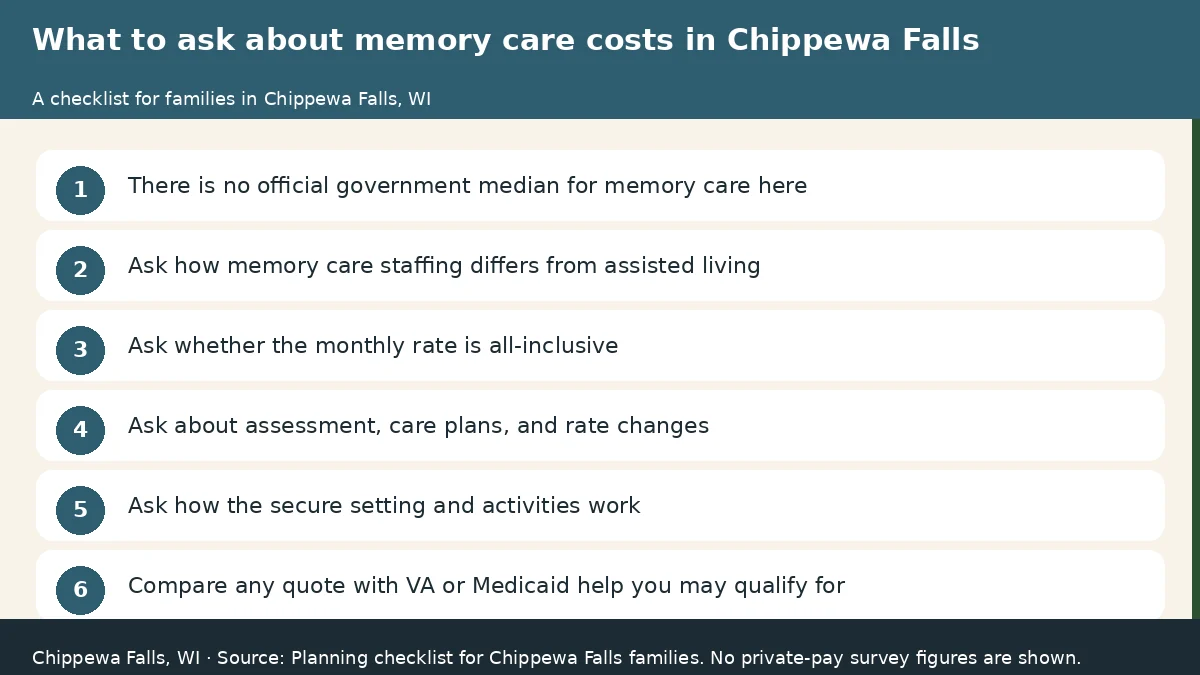
There is no official federal or Wisconsin survey that publishes a private-pay median for memory care in Chippewa Falls. Memory care is usually priced higher than standard assisted living because of staffing, training, and a more structured setting, but the only reliable figure is a written quote.
Medicare does not pay for room, board, or ongoing custodial care in assisted living if that is the only care someone needs (Medicare.gov: long-term care coverage).
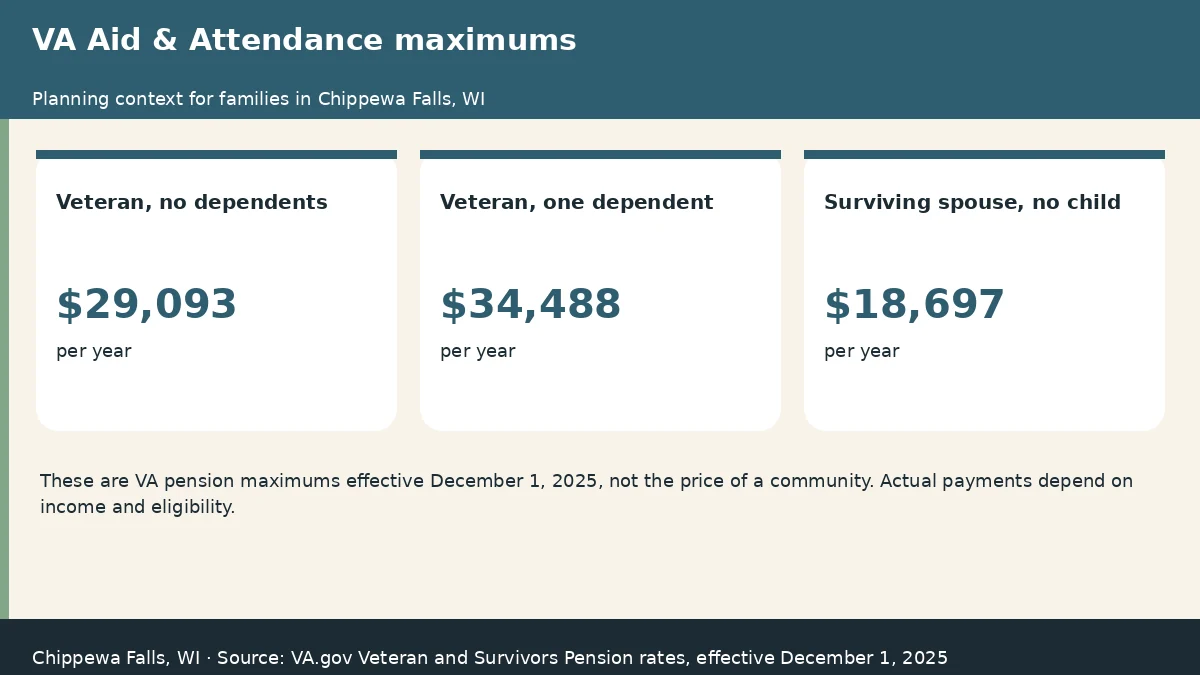
Eligible wartime Veterans and surviving spouses can review VA pension with Aid and Attendance. As of December 1, 2025, the maximum annual pension rate with Aid and Attendance is $29,093 for a Veteran with no dependents and $34,488 for a Veteran with one dependent (current VA pension rates). A surviving spouse’s Aid and Attendance maximum is $18,697 a year with no dependent children (VA Survivors Pension rates). These are benefit limits, not the price of a Chippewa Falls community. The net worth limit for these pensions is $163,699 from December 1, 2025, through November 30, 2026.
For local public-benefit counseling, start with the federal Eldercare Locator at 1-800-677-1116, which connects families to the Area Agency on Aging that serves Chippewa Falls, Wisconsin.
When a parent's memory changes reach the point where they are no longer safe at home, families in the Chippewa Valley often turn to memory care. It is one of the hardest decisions a family makes, and the cost questions come with it. How much more does memory care cost than assisted living? Is there a local figure? What exactly are you paying for?
This guide explains what the published data shows, where it falls short, and how to get a clear quote.
The honest starting point: no separate local survey figure
It reports assisted living, home care, adult day health care and nursing homes. So there is no official "Chippewa Falls memory care median" to quote, and you should be cautious of websites that present one without saying where it came from.
What we can do is combine two reliable sources:
But it gives a reasonable sense of the typical premium. It tells you to expect memory care quotes in the Eau Claire area to sit noticeably above the local assisted living median, but the only reliable local number is the one a community gives you in writing.
Why memory care costs more
Memory care is a form of assisted living designed for people living with Alzheimer's disease or other dementias. The higher cost reflects real differences in how care is delivered:
- More staff time. Residents often need more frequent help and cueing through the day, and sometimes at night.
- Specialized training. Staff receive training in dementia communication and approaches to distress. At Dove Healthcare Rutledge, caregivers working with residents living with dementia receive ongoing specialized dementia training, as described on our care page.
- A secure environment. Memory care settings are designed to reduce the risk of someone leaving unsafely, with secured exits and layouts that are easier to navigate.
- Structured days. Routines and activities are planned around the abilities and interests of people with memory changes.
None of this cures or reverses dementia. What it can offer is a safer, calmer setting with people who understand how to support someone through the day.
How Chippewa Falls communities price memory care
Pricing models vary:
- All-inclusive. One monthly rate covers housing, meals, and memory care services.
- Base plus memory care fee. An assisted living base rate plus a set monthly memory care charge.
- Care levels. A base rate plus a charge that rises as care needs increase.
Ask each community to write out exactly what is included, and what would cause the price to change. Families are often surprised by increases as needs progress, so it is worth asking about this directly at the start.
Comparing memory care with other options
Source: .
For someone who needs supervision around the clock, in-home care becomes very expensive.
What families in the Chippewa Valley often weigh
Cost is rarely the only factor. Families here often tell us they are weighing distance as much as price: whether a community is close enough for a spouse to visit daily, whether grandchildren in Eau Claire or Menomonie can stop by after school, and whether winter driving will make visits harder. A community that is slightly more expensive but ten minutes from home may serve the family better than a cheaper one forty minutes away, especially when frequent visits help a person with memory changes feel settled.
It is also worth thinking about continuity. Some families move a parent into assisted living first and then into memory care later, sometimes within the same community. Moving once rather than twice can be easier on someone with dementia. Ask whether a community offers both levels and how transitions between them are handled and priced.
Help paying for memory care in Wisconsin
- Family Care and IRIS. Wisconsin's Medicaid long-term care programs can pay for care services in certain settings, but not room and board. Family Care members may live in a licensed community-based residential facility, a licensed or certified adult family home, or a certified residential care apartment complex (Wisconsin DHS, assisted living and Medicaid).
- VA Aid and Attendance. Eligible veterans and surviving spouses may receive a pension supplement when they need help with daily activities (VA pension rates).
- Long-term care insurance. Many policies cover memory care once a cognitive impairment is documented.
Our article on paying for assisted living in Wisconsin covers each option.
Questions to ask about memory care pricing
- Is memory care priced as a separate rate, a fee on top of assisted living, or by care level?
- What exactly does the memory care rate include?
- What would trigger an increase, and how much notice do you give?
- Are there one-time fees?
- How do you handle residents whose needs change significantly?
- Do you accept Family Care, and are you contracted with the managed care organizations serving Chippewa County?
Talk with us
Dove Healthcare Rutledge, at 300 Bridgewater Avenue in Chippewa Falls, offers assisted living and memory care with person-centered routines and nursing oversight. We do not publish fixed rates online, because a fair quote depends on each resident's needs. Call (715) 723-5566 or visit our contact page to ask about current pricing and to see the community.
Frequently asked questions
How much is memory care in Chippewa Falls?
There is no official memory care median for the area. Ask communities directly for current memory care rates.
Why is memory care more expensive than assisted living?
Memory care typically involves more staff time, specialized dementia training, a secure environment, and structured daily programming, all of which add to costs.
Does Wisconsin Medicaid pay for memory care?
Family Care and IRIS can pay for care services in eligible settings, but they do not cover room and board. Eligibility depends on care needs and finances, determined through the local aging and disability resource center and the state.
Is memory care cheaper than a nursing home?
Memory care is usually less than nursing home care, though it depends on the community and the level of support needed.